

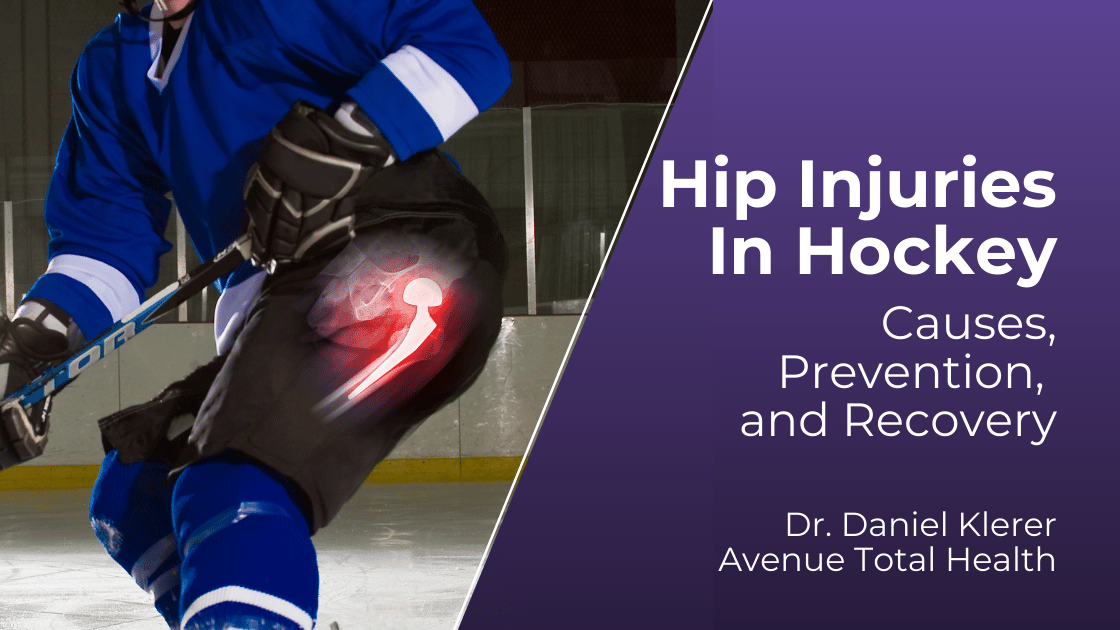
Hockey is Notorious for Hip Injuries
In Toronto, and Canada in general, hockey is one of our greatest pastimes. But among the most common and disruptive problems faced by hockey players at every level, from youth leagues to the professional ranks are hip injuries. The fast pace of the game, repeated forceful skating strides, sudden changes of direction, and frequent body contact place exceptional demands on the hip joint. When combined with the unique posture of skating—deep flexion, external rotation, and powerful extension—it’s no surprise that the hip becomes a vulnerable area for overuse and acute injuries.
One of the most frequent hip issues in hockey is hip flexor strain. These muscles are responsible for driving the skating stride and lifting the leg, and they experience constant load during acceleration. Players who skate with a forward-leaning posture or who increase training volume too quickly are especially prone to tightness and micro-tears. Symptoms often include groin or front-hip pain, stiffness, and reduced stride power.
Another major concern is femoroacetabular impingement (FAI), a condition in which extra bone on the femoral head or hip socket causes the two structures to rub abnormally. Hockey players are at higher risk for FAI because their hips repeatedly rotate outward during skating and pivoting. Over time, this can damage hip cartilage and the labrum, the ring of tissue that stabilizes the joint. Labral tears are a common progression of untreated FAI and may require surgery when conservative treatments fail.
Sports hernias—often referred to as athletic pubalgia—also affect many hockey athletes. Although technically not a true hernia, this condition involves weakening or tearing of the soft tissue in the lower abdominal or groin region. The quick twisting and forceful cutting motions that define the sport can strain these tissues. Players usually describe chronic groin pain that worsens with explosive movements, shooting, or prolonged skating.
Acute injuries also occur, such as hip pointer contusions from collisions with the boards or other players. These bruises on the iliac crest (the top of the hip bone) are extremely painful but generally heal with rest and protective padding. Less common but more severe injuries include dislocations and fractures, typically resulting from high-impact crashes.
Preventing hip injuries in hockey requires a combination of strength training, flexibility, and smart workload management. Strengthening the core, glutes, and deep hip stabilizers can reduce strain on the smaller muscle groups. Mobility work—including hip flexor stretching, adductor stretching, and rotational mobility drills—helps counteract the tightness that develops from hours on the ice. Proper warm-ups and cool-downs, as well as monitoring for early signs of discomfort, are essential. Coaches and trainers increasingly emphasize off-ice conditioning programs tailored to improve hip function and skating efficiency.
When injuries do occur, early diagnosis leads to better outcomes. Most hip strains and overuse injuries respond well to rest, physical therapy, and gradual return-to-play progression. For structural issues like FAI or severe labral tears, surgery may be necessary, but modern arthroscopic techniques allow many players to return to high-level competition.
In a sport defined by speed, agility, and physicality, preserving hip health is critical. Understanding the risks—and taking proactive steps—can help hockey players stay strong, mobile, and competitive throughout their careers.
If you’re in the North York or GTA area and you’ve suffered a hip injury from hockey or other high-intensity activities, call me, Dr. Daniel Klerer at Avenue Total Health, located on the corner of Avenue Road and Wilson Ave. You can also follow Dr. Klerer on Instagram.
